
Squamous Cell Carcinoma of the Eyelid
The second most common eyelid cancer — keratotic, indurated lesions with a higher risk of spread, and their surgical treatment.
Medically reviewed by EyePlastics Medical Editorial BoardASOPRS oculoplastic surgeonsLast updated June 2026
Part of our complete guide to Eyelid Skin Tumors — this page covers squamous cell carcinoma in depth.
Squamous Cell Carcinoma
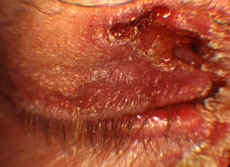
Squamous cell carcinoma (SCC) is the second most common eyelid malignancy, accounting for ~5–10% of eyelid cancers. It arises from keratinocytes of the epidermis and has a significantly higher metastatic potential than BCC — regional lymph node metastasis occurs in 1–24% of periocular SCC depending on subtype, depth, and location.
Risk factors: cumulative UV exposure, actinic keratosis (precursor lesion), immunosuppression (solid organ transplant recipients have a dramatically increased risk), xeroderma pigmentosum, chronic inflammation or scarring, and prior radiation therapy.
Clinical appearance: SCC often arises within an actinic keratosis and presents as an indurated, erythematous, scaly plaque that may ulcerate. Unlike BCC, the border tends to be less well-defined and the lesion may feel firm or fixed to deeper structures. The lower lid and lid margin are common sites.
High-risk features that increase recurrence and metastasis risk: perineural invasion, tumor thickness > 2 mm, poorly differentiated histology, recurrent lesion, immunosuppressed host, and location at the lid margin or medial canthus. High-risk periocular SCC warrants sentinel lymph node biopsy or elective parotid/neck imaging.
Treatment: Mohs surgery with same-day reconstruction is preferred for primary periocular SCC. Wide local excision with frozen-section control is an alternative. Adjuvant radiation therapy is used for perineural invasion, positive margins that cannot be cleared surgically, or regional nodal disease. Anti-PD-1 therapy (cemiplimab) is approved for locally advanced or metastatic SCC not amenable to surgery or radiation.
Frequently Asked Questions
- Is squamous cell carcinoma more serious than basal cell?
- It can be — squamous cell carcinoma has a higher (though still modest) risk of spreading to lymph nodes than basal cell carcinoma, so prompt diagnosis and complete removal matter.
Find a Specialist
Connect with a board-certified oculoplastic surgeon who specializes in squamous cell carcinoma of the eyelid.
Search the Directory →